Wednesday, 11 October 2017

ANTI PUMPING FOR CIRCUIT BREAKER

Function of Anti-Pumping in Circuit Breaker is to prevent multiple breaker closures due to persistent closing command. For instance, if the operator gives a consistent closing command to the breaker by pressing the close button and the breaker closes. However, a fault in the system causes the breaker to trip. Since the close command is still in the pressed condition, there is a chance of the breaker closing again and being tripped by the release multiple times. This can severely damage the contacts and closing mechanism of the breaker.
Anti-pumping feature prevents this by ensuring that the breaker closes only once for one close command.

Benefit:
Anti-pumping prevents multiple breaker closures due to persistent closing commands. It prevents the breaker from reclosing in the event of faults in case there is a continuous closing command. This ensures reliability of the entire distribution system and protects the breaker from severe damage.

Types of Anti-Pumping:
Following anti-pumping methods are used to ensure reliability of entire distribution system:

Mechanical anti-pumping
Mechanical anti pumping is achieved by providing linkage interlocks which ensures that anti-pumping lever does not reset until the manual persistent closing command is relieved. Even in case of a fault, breaker trips but the anti-pumping lever remains in the downward position until a persistent command is relieved. Hence the breaker can be reclosed only after a fresh command is given. It is available in all ACBs irrespective of Manual operation (MDO/MF type) or Electrical operation (EDO/EF type).

Working Principle of Mechanical Anti Pumping:
Closing command (“manual” or “electrical –through closing coil”) to mechanism closing shaft is given through an inclined component called anti pumping lever (APL). Breaker can be closed only when this APL is in UP condition (pic1). This happens when all the ‘Ready to close conditions’ are met. When in UP condition, ON command is transmitted through APL’s arm to closing shaft. However, when this component is in DOWN condition (pic2) breaker cannot be closed.
Persistently keeping the close push button in ON condition (continuous ON command), will not allow the APL to come in UP position. So, breaker will not close. Only when the close push button would be reset and fresh closing command will be given, the breaker will close. This explains the working of mechanical anti-pumping.

Electrical anti-pumping:
Electrical Anti-Pumping is available in all electrically operated ACBs (EDO/EF type). In case persistent closing command is given to the breaker from remote location (through closing release), function of Electrical anti pumping is to cut off the supply from closing release till the closing command is not reset and fresh closing command is given. This prevents the breaker from multiple closing operations due to continuous closing command. It can be achieved through the following methods:

a) By providing external circuit:
To achieve this anti-pumping there is a need for an auxiliary contactor or a relay which will get actuated by the first closing command and will break the closing circuit and will prevent the breaker from closing after the breaker has tripped on fault, this anti-pumping contactor or relay is reset only when the closing command is removed, thus proving anti-pumping.

b) By having inbuilt feature in closing release (CR):
In ACBs, closing release consists of an electronic circuit to ensure no watt loss, in spite of continuous power supply, thus saving energy. When a closing command is given, closing coil of the circuit breaker gets supply through an electronic circuit which comprises of IC555 timer. The closing coil is energized and the breaker closes. The closing command persists only for the 500ms time duration. In order to close the circuit breaker again, the closing coil circuit will have to be reset only when the closing command is removed.

This ensures that once the breaker has closed and tripped on fault the breaker can close again only after the first closing command is removed and a fresh closing command is given, thus providing anti-pumping feature.
Sunday, 8 October 2017

ELECTRICAL MOTOR EFFICIENCY

The New IS: 12615
The New IS: 12615 are based on the International Standard IEC 60034-30 (2008) which defines New Efficiency Classification for single speed, three phases, induction motors. The new IS:12615 covers single speed, three-phase, 50Hz, cage induction motors that:
  • Have rated voltage ≤1000V;
  • Have a rated output 0.37kW ≤ P N  ≤  375kW;
  • Have either 2, 4 or 6 poles;
  • Meet frame size to output relation as stipulated in IS:1231 (for outputs covered by IS:1231);
  • Are rated on the basis of either duty type S1 (continuous duty) or S3 (intermittent periodic duty) with rated cyclic duration factor of 80% or higher;
  • Are capable of operating direct on-line;
  • Are designed for operation on virtually sinusoidal and balanced voltage conditions
  • Designed for an ambient temperature not exceeding 40°C and altitude not exceeding 1000m;
  • Have degree of protection IP44 or superior;
  • Have method of cooling IC411 in accordance with IS 6362 / IEC 60034-6;
  • Have service factor not exceeding 1.0.
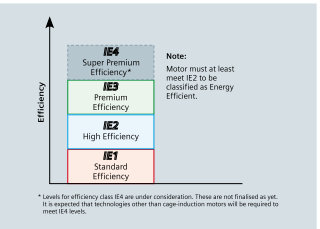
The Efficiency classes defined are:
IE1 – Standard Efficiency
IE2 – High Efficiency
IE3 – Premium Efficiency
The New IS:12615 also stipulates that for motors to be classified as “Energy Efficient”,  these must meet at least IE2 efficiency values.
Energy efficient motors, IE1 motors, IE2 motors, IS 12615, High efficiency motors

GENERATOR PROTECTIONS

Generator Protection, Typical Schemes:

1.0 With increasing complications in the power system, utility regulations, stress on cost reduction and trend towards automation, Generator protectionhas become a  high focus area.     State of the art, microcontroller based protection schemes from L&T offer a range of solutions to customers  to address the basic protections and control requirements depending upon the size and plant requirements.

2.0    Generators  – size less than 300 KVA

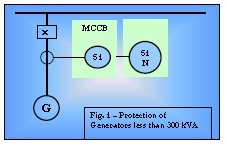
Normally these generators are controlled by MCCBs, which offer O/C and short circuit protections. It is advisable to have following protections in addition to MCCB (Fig.1):
SLD1
E/F protection (51N) : This will protect the generator from hazardous leakages  and ensure operator safety. Many SEBs have already made  E/F protection as mandatory.
3.0    Generators – size 300 to 1 MVA
There are two major differences when compared with the small machines considered in section 2.0.
  • IDMT Over current + E/F relay will be required addition to normal MCCB or ACB releases – since the generator may need shorter trip times for faults in the range 100% to 400% level.     
  • By virtue of larger power level, any faults inside the stator or fault  between the neutral of the machine and the breaker terminals can reach very high intensity.
Such internal faults must be cleared instantaneously. Normal IDMT over current / E/F relays are not adequate to monitor this internal fault condition. A separate relay scheme is required to monitor this internal fault status – otherwise the machine can circulate very high fault currents resulting in severe damage.
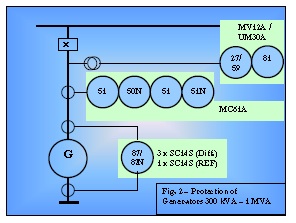
A high impedance differential relay scheme, is the best suited for this purpose (Fig.2). If the neutral is formed inside the machine, the differential relay scheme will not be possible. Care should be taken to provide adequate no. of CTs as shown in the diagram.
SLD2
  • Machines of this size are likely to have external controls for frequency and excitation – so that they can be run in parallel with other power sources (other generators on the same bus  or the local grid).  This necessitates voltage and frequency related protections as well.

4.0    Generators – Size 1 MVA to 10 MVA

Being a medium sized generator, it will need more comprehensive protection Both for the stator side and the rotor side.

4.1     Stator side protections:

  • Voltage restrained Over Current Protection (50V / 51V): Normal IDMT O/C will not work here – when a over current fault occurs, due to higher current levels, there would be a drop in terminal voltage. For the same fault impedance, the fault current will reduce (with respect to terminal voltage) to a level below the pick up setting. Consequently normal IDMT may not pick up. It is necessary to have a relay whose pick up setting will automatically reduce in proportion to terminal voltage. Hence the over current protection must be voltage restrained. Two levels of Over current protection is required –  low set  and highest ( for short circuit protection).
  • Thermal Overload (49) : This protection is a must – it monitors the thermal status of machine for currents between 105% to the low set O/C level ( normally 150%).
  • Current Unbalance (46) : Generators are expected to feed unbalanced loads – whose level has to be monitored. If the unbalance exceeds 20%, it may cause over heating of the windings. This heating will not be detected by the thermal overload relay – since the phase currents will be well within limits. A two level monitoring for unbalance is preferred – first level for alarm and the second level for trip.
  • Loss of excitation (40): When excitation is lost in a running generator, it will draw reactive power from the bus and get over heated. This condition is detected from the stator side CT inputs – by monitoring the internal impedance level & position of the generator. 
  • Reverse Power (32) : Generators of this size may operate in parallel with other sources, which may cause reverse power flow at certain times ( during synchronization or when there is a PF change due to load / grid fluctuation or when there is a prime mover failure). When reverse power happens, the generator along with prime mover will undergo violent mechanical shock – hence reverse power protection is absolute must. 
  • Under power (37) : It may not be economical to run generators below a certain load level. This protection will monitor the forward power  delivered by the machine and give alarm when the level goes below a set point. 
  • Under / Over Voltage (27 / 59 ) : This will protect the machine from abnormal voltage levels, particularly during synchronization and load throw off conditions. 
  • Under / Over frequency (81): This will protect the machine from abnormal frequency levels, particularly during synchronization and load throw off conditions. This will also help in load shedding schemes for the generator. 
  • Breaker Failure Protection: This protection detects the failure of breaker to open after receipt of trip signal. Another trip contact is generated under breaker fail conditions, with which more drastic measures (like engine stoppage, opening of bus coupler etc) can be taken. 
  • Stator Earth fault (64S): This protection detects the stator earth fault. 
  • Differential Protection (87G) : This protection is very important – since the machines of this size have to be protected for severe damages that may occur due to internal faults. Considering the large power levels, it is necessary to have a percentage biased, low impedance differential relay. 
  • PT Fuse Failure Protection: This relay will detect any blowing of PT secondary fuse  and give a contact which can be used to block the under voltage trip.

 4.2     Rotor side protections :

Generators of this size, will need rotor side protections listed below :
  • Rotor Excitation Under Current: This is a DC under current relay which will monitor the excitation current. 
  • Rotor Excitation U/V (80): This is a DC under voltage relay, which will monitor rotor voltage. 
  • Diode failure Relay: Brushless excitation systems will have rotor mounted diodes, which can become short or open during operation. Diode Failure relay (RHS) will monitor the condition of these diodes , for both open circuit and short, and give alarm. 
  • Rotor Earth Fault (64R): This Relay will monitor the rotor winding status for the Earth fault.
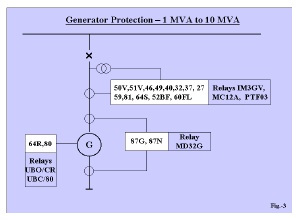
Please see Fig 3 for the scheme with relays as above.
sld3

5.0    Generators above 10 MVA

For large generators above 10 MVA size, the philosophy of main protection and back up protection has to be followed. In addition to the protections listed in Section 4.0, following extra protections are to be considered
  • 100% Earth Fault Protection: This will help in sensing earth faults close to neutral. 
  • Inadvertent Breaker Closure: This will avoid closing of generator to bus during coasting to stop, or when stand still or before synchronise. 
  • Under Impedance: This will be required as a back up protection for the whole system including the generator transformer and the associated transmission line. If the distance relay fails to pick for some reason, this under impedance function will pick up and save the generator. 
  • Over Excitation: This will protect the generator from Over fluxing conditions.
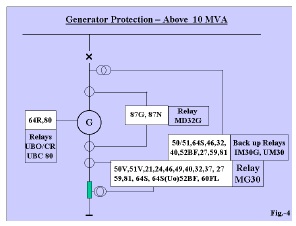
Please see Fig. 4 for the SLD.
sld4

6.0    Generator connected in parallel to grid:

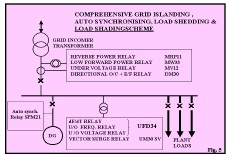
Whenever generators are running parallel to grid,  a comprehensive Auto Synchronizing & Grid Islanding Scheme will be required. This scheme will help in synchronizing the generator to the bus and opening the incomer breaker of the plant whenever there is a severe grid disturbance, thus protecting the generator from ill effects of disturbed grid. Please see Fig. 5.
sld5

7.0    Generators connected in parallel on a common bus:

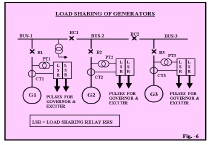
Whenever more than one generator is operating in parallel, it is necessary to see that the plant load is equally shared by the generators in parallel. If there is unequal sharing, there would severe hunting amongst the generators and eventually this will lead to cascaded tripping of all generators, causing a total black out. Please see Fig 6 for a representative scheme of load sharing for three generators.
sld6